Settlement Orchestration Patterns Observed in Aggregator Models for On-Demand Service Providers
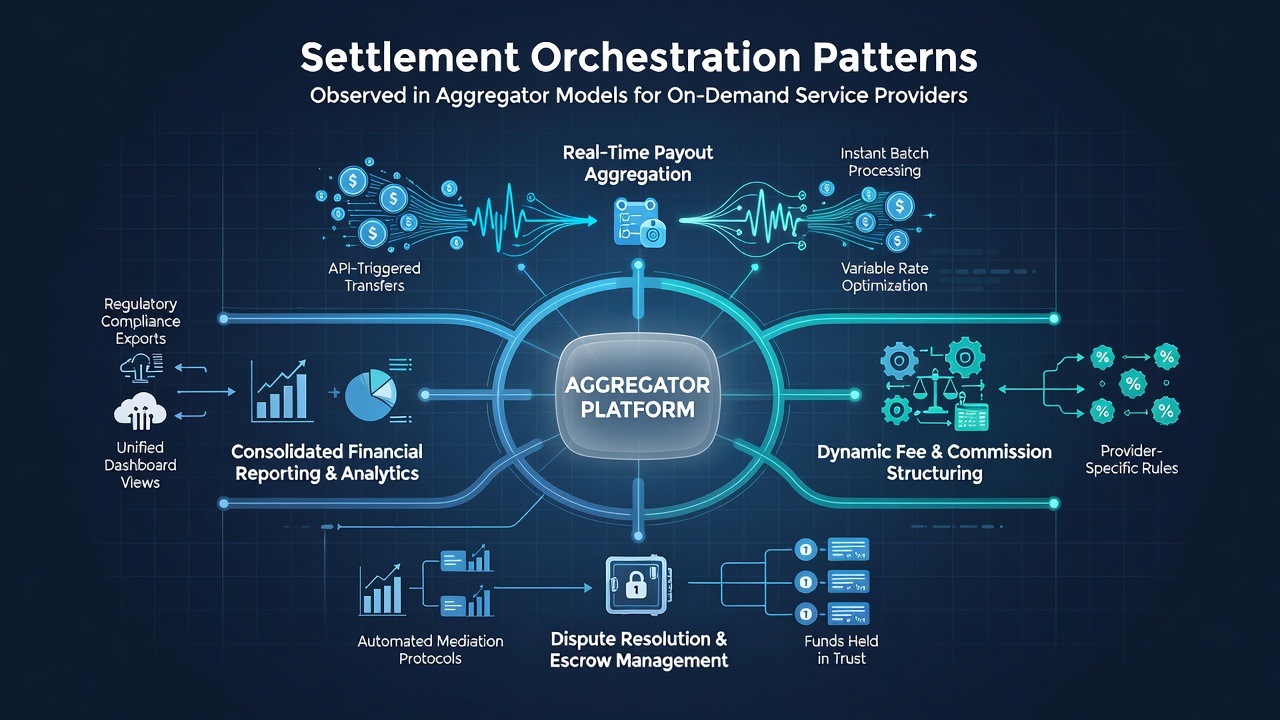
Settlement orchestration in aggregator models coordinates the movement of funds from customer payments through central platforms to individual service providers such as drivers and delivery personnel, and these systems handle high volumes of micro-transactions while applying fee deductions and compliance checks at multiple stages. Aggregators act as intermediaries that collect revenue on behalf of numerous independent operators, then distribute net amounts according to predefined rules that account for commissions, taxes, and promotional adjustments.
Core Components of Aggregator Settlement Systems
Platforms organize settlements around a central orchestration engine that receives transaction data in real time, validates each entry against provider contracts, and routes funds through banking partners or alternative payment rails. This engine applies logic that splits payments automatically, with one portion directed to the service provider and another retained for platform fees, while additional rules trigger holds for dispute resolution or regulatory reporting requirements. Observers note that such engines often integrate with multiple acquiring banks to optimize for cost and speed, switching between processors based on transaction size, location, and provider banking details.
Observed Orchestration Patterns in Practice
One recurring pattern involves batch processing at fixed intervals, where transactions accumulate throughout the day before a single settlement run executes transfers to providers, and this approach reduces per-transaction fees while allowing time for fraud screening and reconciliation. Another pattern uses event-driven triggers that initiate partial settlements immediately upon service completion, which suits high-frequency providers who prefer quicker access to earnings. Researchers have documented hybrid models that combine both methods, routing small daily earnings through instant channels while consolidating larger weekly payouts into lower-cost batches.
Data from payment networks indicates that rule-based routing has become common in aggregator setups, with algorithms evaluating factors such as provider risk scores, regional banking hours, and currency conversion needs before selecting a settlement path. In June 2026, updates to cross-border payment standards in several markets prompted many platforms to incorporate dynamic ledger updates that reflect real-time exchange rates during orchestration.
Integration with Provider Ecosystems
Aggregators maintain profiles for each service provider that include banking credentials, tax identifiers, and historical settlement preferences, and the orchestration layer queries these profiles at every settlement cycle to apply correct deductions and compliance flags. Take one logistics platform that expanded operations across multiple regions: its system automatically adjusted settlement timing to align with local banking cutoffs, which reduced failed transfers and associated retry costs. Those who manage such platforms report that maintaining accurate provider data remains essential because errors in routing information can delay funds for days and trigger additional verification steps.
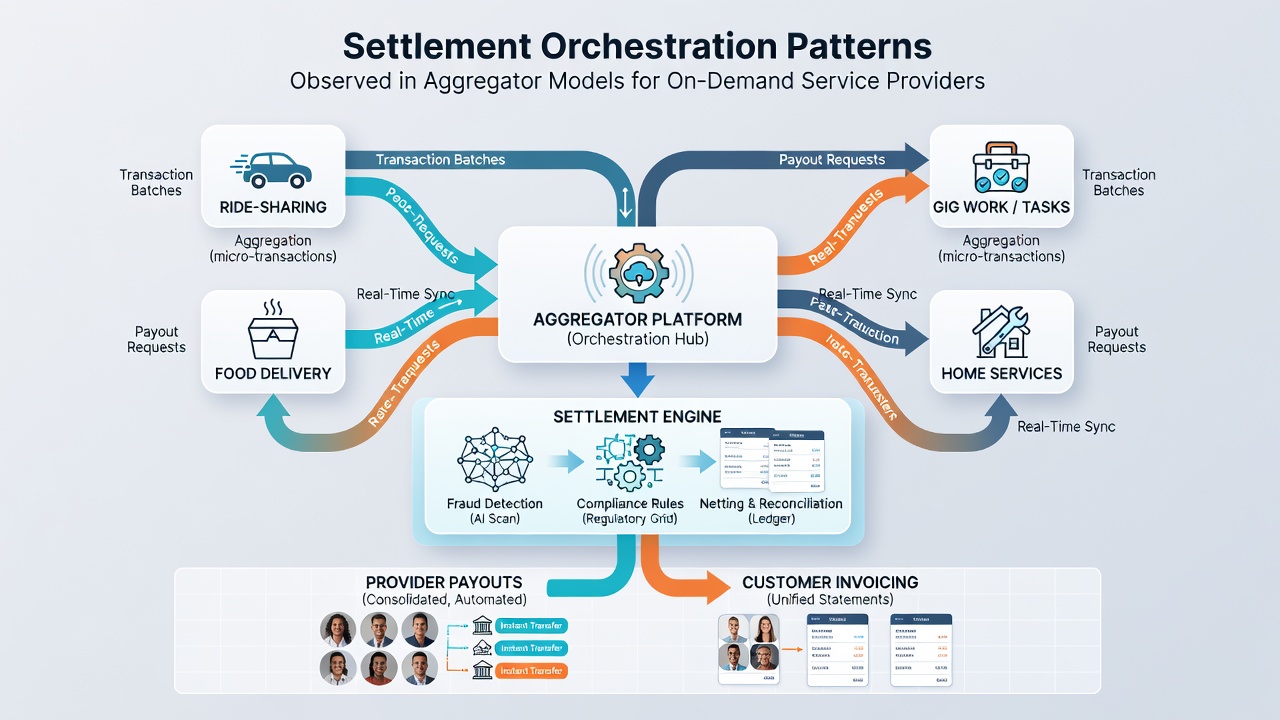
Multi-tier orchestration appears frequently when sub-aggregators or fleet managers sit between the main platform and individual providers, and the central engine must then cascade payments through intermediate accounts while preserving audit trails for each layer. This structure supports larger operations where fleet owners handle their own driver payouts, yet it requires precise sequencing so that funds reach the final recipients without unnecessary delays or duplicate fees.
Regulatory and Compliance Influences
Payment orchestration systems incorporate checks that align with requirements from bodies such as the Federal Reserve in the United States and the Bank for International Settlements guidelines on fast payments, and these checks often include automated generation of tax forms or suspicious activity reports during settlement runs. In regions following the European Central Bank's instant payment frameworks, aggregators have adjusted orchestration logic to support same-day or near-real-time transfers without violating anti-money laundering thresholds. Academic studies from institutions tracking platform economies show that platforms investing in modular orchestration layers adapt more readily to new rules, because individual components can be updated without rebuilding the entire settlement pipeline.
Technical Challenges and Adaptations
High transaction volumes create pressure on orchestration engines to maintain low latency while performing multiple validations, and platforms address this by deploying parallel processing clusters that handle subsets of transactions simultaneously before merging results into unified ledgers. Reconciliation discrepancies between customer charges and provider credits trigger automated investigation workflows that flag items for manual review, which helps preserve accuracy across thousands of daily settlements. Observers note that fallback mechanisms become critical during processor outages, rerouting settlements through secondary banking partners to avoid service disruptions for providers who rely on timely access to funds.
Conclusion
Settlement orchestration patterns in aggregator models continue to evolve as on-demand platforms scale and regulatory environments shift, with systems increasingly relying on configurable rules engines, multi-rail routing, and layered reconciliation to manage complexity. Data from industry reports shows steady growth in the adoption of hybrid settlement approaches that balance speed and cost, and platforms that maintain flexible orchestration layers demonstrate greater resilience when adapting to new compliance demands or expanding into additional markets. These patterns reflect ongoing efforts to streamline fund distribution while meeting the operational needs of diverse service provider networks.